
Great production starts with colourful copywriting that activates senses and stimulates imagination, we’ve learned from Z100’s former Creative Services Director, Dave Foxx.
Following a radio career of 35 years, including almost 3 decades at Z100 in New York City, Dave Foxx moved to Austin, Texas from where he enjoys life, continues to do production & voiceover work, and shares radio production, imaging, branding & copywriting tutorials on his blog. At The Imaging Days 2016, he spoke about how to use sounds and words effectively to affect your listener’s emotion. “If you can create that kind of sensation, you’re a thousand miles ahead.”
“You want that production to be up front”
Dave Foxx explains that branding your work will make your station recognisable and give your brand personality, allowing it to stand out above the music you play (image: Thomas Giger)
Surround yourself with achievers
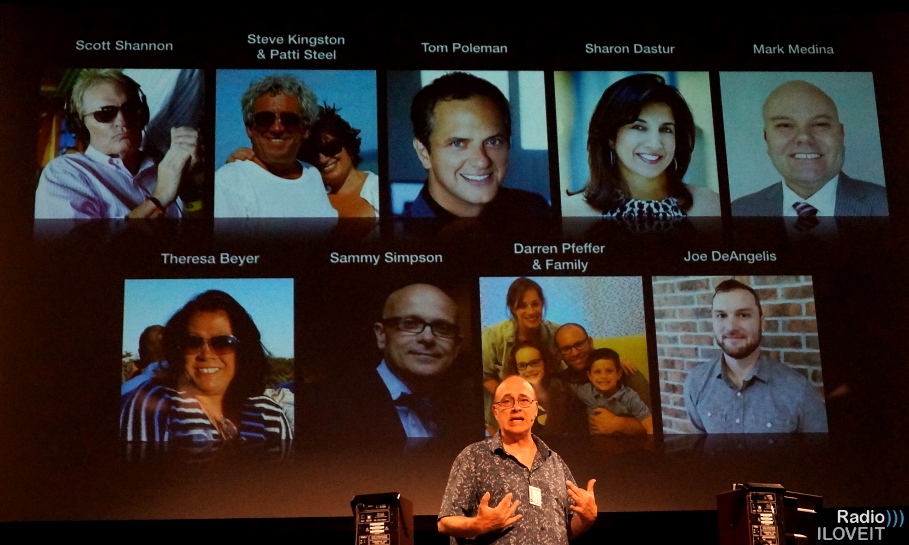
“I’ve had the rare opportunity to work with some of the best and brightest minds in radio production, promotion and programming”, Foxx says. Z100’s launch program director (and original Morning Zoo keeper) Scott Shannon was his first boss, although it was actually Steve Kingston who hired him. After they left, he got to work with Tom Poleman. He calls the current President of National Programming Platforms at iHeartRadio “one of the best programmers that I’ve ever worked with” and “quite a nice guy”. Poleman’s successor Sharon Dastur was followed by Mark Medina (“one of my favourite people in the world”). He also honours the promotion managers during his almost 29 years at ‘Z’, such as Sammy Simpson (“he epitomises that outside-the-box and what-box kind of thinking that you expect from a good promotions director”).
Add your personal touch
These people collectively taught him the essence of branding, that “consistent, underlying message” that goes with everything we produce. Dave Foxx’ advice is to not just brand your radio station, but to brand your own work as well. “Most of the things your station does with branding are decided way above your pay grade. They were certainly above mine.” Things like formats and clocks, including how stopsets are constructed and where they are placed, are part of the long-term strategy, while imaging producers are dealing with the short-term tactics. “But: if you brand your work, you can do amazing things. It makes your work instantly recognisable. When you heard my station, without hearing the name Z100 or New York’s #1 Hit Music Station or Today’s Best Music or whatever the strapline was at the time, you knew it was Z100, because it had a certain sound. ‘Tatoo’ your work, so it’s uniquely yours and adds to the radio station.”
Give your station personality
The other benefit of adding your personal touch is giving your station character: “The work you do, is on the air 24 hours a day, every day. You’re ‘on’ more than any of the jocks”, Foxx emphasises, pointing out you can make a huge difference when you’re not only the imaging producer, but also the (main) station voice. “Your VO becomes the personality of your station. If your work is branded well, it will help push along no matter what the promotion is. People will instantly know that it’s yours, and relate to it in a certain way. It will make every element ‘pop’ on the air. You want it to stand out from and be bigger than the music; make the station sound larger than life.” While it’s very true for CHR, he feels like this can work for basically any format. “You want that voice to stand out; you want that production to be up front.”
“Find that target audience of one”
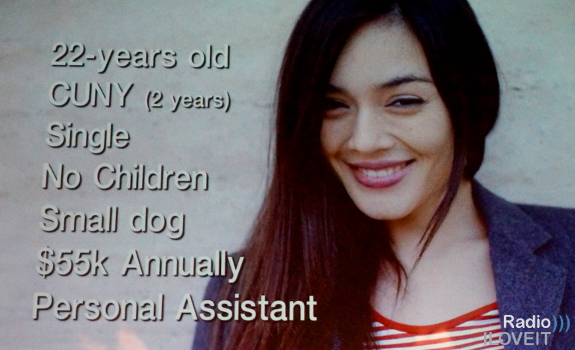
Imaginary listener ‘Mika’ has inspired Dave Foxx’ production work for Z100 (image: Thomas Giger)
Address your target demo
Dave Foxx makes clear that it’s key to tailor your station (imaging) to match the individual mindset and lifestyle of your target audience. “We’re talking about zeroing in, and hitting the bullseye in the middle of that target demo. You need a target audience of one.” When he was at Z100, he used a fictional persona named ‘Mika’ as the model listener. Mika is a 22-year-old, fairly successful young woman. She is single, although she’s dating, and has no children, but one small dog. Before becoming personal assistant of a Wall Street broker, a well-paid job at $55.000 a year, Mika studied a few years at the City University of New York. “Everything I produced at Z100, was targeted at her; not some amorphous group of women.” He recommends reading The 22 Immutable Laws of Branding, and quotes the second law; narrow focus creates broader appeal (‘As you focus the brand more sharply on a single aspect, virtue or quality, it grows in strength’).
Visualise your model listener
As many program directors are ‘focusing’ on the whole target audience, Foxx’ advice for imaging producers is to go their PD and ask them what exactly their target audience is, and then (together) define the listener personification, so you can tailor all your copywriting, voicing and producing to that single core listener. “Until that happens, you’re shooting in the dark. Am I trying to appeal to 3.5 million Mika clones? No. Just the opposite.” He explains that a station tailored to a 22-year-old woman will appeal to every 30-something soccer mom who has to get up in the middle of the night to take care of her young children and has bills to pay. She’s wishing to be in her twenties again; free of responsibilities. Mika’s lifestyle will also appeal to every teen college girl that dreams of freedom from teachers and parents. “When you try to appeal to everyone, you’ll end up appealing to no one. Find that target audience of one.”
Align your jingles & production
When your station is using jingles, it’s good to sit down and listen to the entire package, from the beginning to the end, two or three times. Assuming that the production company has made the package an exact fit with the station’s format and audience, Dave Foxx thinks that a jingle package can be a good guide for your own production, such as promos and sweepers. “If you get your inspiration from there, it makes it a lot simpler to appeal to ‘Mika’. Learn the essence of your jingles.” When quoting Steve Kingston, who once said that jingles are like the artist signature on the bottom of a painting, he feels like your in-house production has to achieve the same. “It needs to identify your station as being your station.” Part of Z100’s identity, from the very start in 1983, is the iconic ‘3-1-5-5’ logo, composed by JAM’s Jonathan Wolfert:
During the 1990s, someone in charge of the station’s programming decides to take jingles off the air, because they are supposedly old-fashioned. Several years later, rapper Ja Rule pays a visit to Z100, and is asked to do some station calls. Without any guidance, he records this:
Fascinated by the incredible power of a sound logo, communicated through jingles that were taken off the air years ago, Dave takes the recording to his PD. “Three days later, jingles were back to stay on Z100.” He feels like it’s an awesome logo as it sounds positive, and is easy to use:
The following part covers Pro Tools plugins & settings. If you’re mostly interested in getting your message across in terms of wordings, you can skip the technical part, and jump to great radio copywriting tips (and more).
“The alpha & omega of most of my promos”

Dave Foxx shares his way of building ‘stationality’ through sound design (image: Thomas Giger)
Develop your signature sound
A memorable melody is one part of a station’s audio fingerprint. There are other parts to it was well, like a certain sound colour. Foxx says that once you have found a signature sound, you can and should use it in every part of your station imaging. “Promos, sweepers, stagers, bumpers, tweeners, top-of-the-hours; it doesn’t matter. Everything you do, goes through that filter you create.” To ensure a recognisable sound, he’s built a standard session template in Pro Tools. After recording his voiceover, he immediately puts a copy of the original on a separate track and mutes it, thus always having a backup of the source audio ready when needed. Plugins on the input side are just a handful, starting with a high-pass filter of which the active setting is named after Z100’s current program director :-).

AVID EQ III 1-Band plugin set to 400 Hz high-pass filtering (image: Thomas Giger)
As he’s often recording in hotel rooms, he’ll add some noise gate, followed by a robust compression:
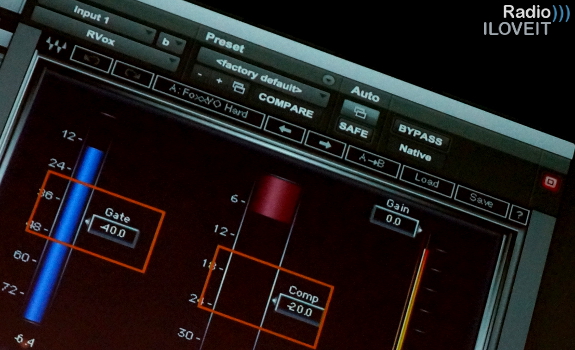
Waves Renaissance Vox plugin set to -40 dB gating, and -20 dB compression (image: Thomas Giger)
For the same reason, he will also include some noise reduction:
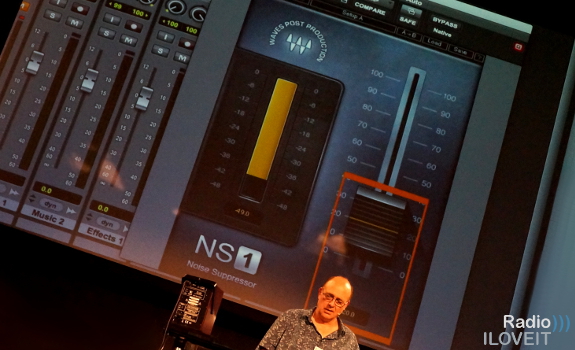
Waves NS1 Noise Suppressor plugin set to 20% noise reduction (image: Thomas Giger)
Next, on his second channel, he will add some equalisation to high-mid frequencies for a “crispy, high-end presence”:

AVID EQ III 7-Band plugin set to 5 kHz HMF frequency, and 6 dB gain (image: Thomas Giger)
Next are some additional gate, compression and noise reduction. To make certain parts of the copy sound even more big in a promo, he will create two mono copies from (a relevant part of) the main track, and move them 20 ms to the right vs. left, achieving a delay effect without using a plugin. First, he makes one mono copy of the main track and nudges it 20 ms forward, then he copies that mono track to a second mono track and moves it 40 ms back, so that these two mono tracks will end up 20 ms on either side of the original VO. He reduces the gain on these additional tracks to just reinforce (and not overpower) the original, and then creates the final voiceover track. Once all voiceover, music & effect parts of the promo are in the right place, Dave Foxx is using a couple of plugins on the output side, starting with a high-pass, 1 kHz filter that is followed by the same EQ as before, plus some “really healthy, extra crispy” compression:
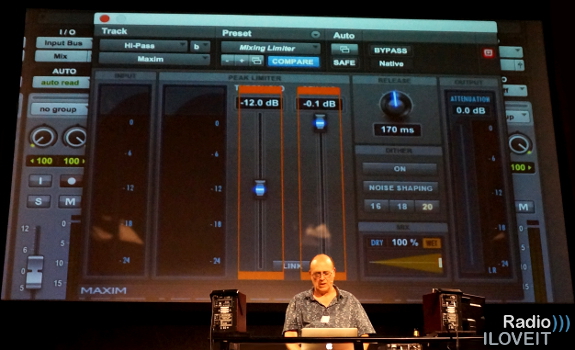
AVID Maxim plugin set to -12 dB threshold, and -0.1 dB output (image: Thomas Giger)
He will now use the plugin version of the above left & right delay concept (which he was deliberately doing manually first to make only a certain phrase stand out) to now put it on all of the voiceover parts in the montage, but only subtle. “I don’t make it very ‘wet’. It’s just there in the background, and part of my way of branding audio.” Not all channels get this treatment; he’s only using it on the main VO. “The drops, and high-pass filter, do not get any of those.”
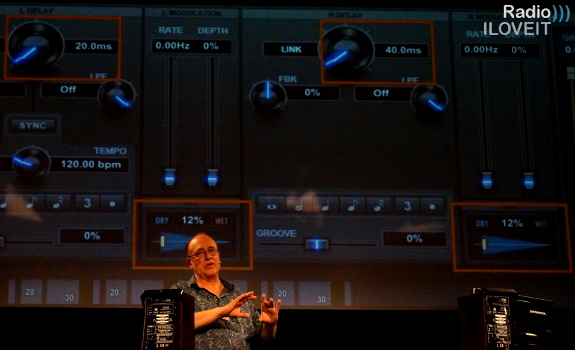
AVID Mod Delay III plugin set to 20 ms left, 40 ms right, and 12% ‘wet’ (image: Thomas Giger)
Foxx will then give all voiceovers, as well as drops and high-pass filter, another round of compression:
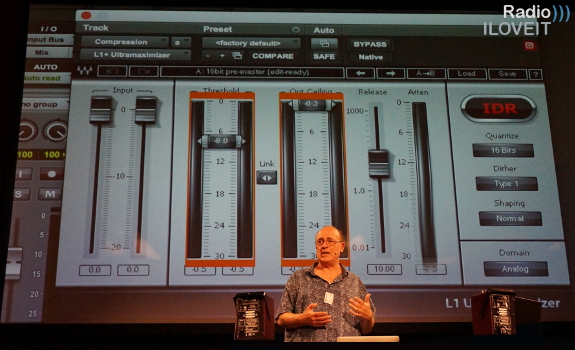
Waves L1 UltraMaximizer plugin set to -8 dB threshold, and -0.3 dB output (image: Thomas Giger)
He’s normally using the L1 with a setting of -6 dB, instead of the -8 dB applied to this particular project; a concert promo with heavier-sounding music hooks and crowd noise. Last, but not least, he will add “very light” compression to the entire mix, “mainly for peak control”, like this:
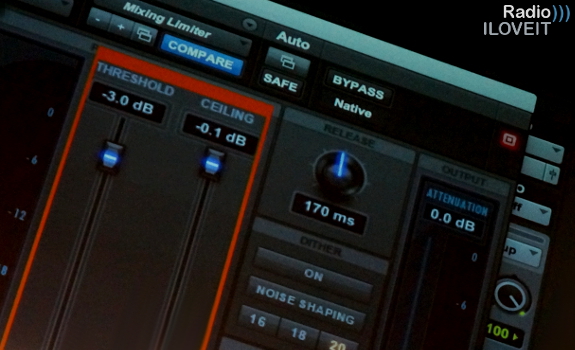
AVID Maxim plugin set to -3 dB threshold, and -0.1 dB output (image: Thomas Giger)
Most of the Waves plugins seen above are part of the Waves Platinum Native Bundle
Put your message first
“That’s the alpha & omega of most of my promos, most of my sweepers, and most of my stagers”, Dave Foxx says, stressing that every production method is personal and subjective. “This is my method; it’s not the method. If anyone feels like they need to add extra compression, add some harmonising… that’s great! It all works, as long as you get the message through. Getting back to the point of matching your in-house production with externally produced jingles, he says that all of Z100’s jingles are currently processed in a similar way. “That’s where I came up with the inspiration for all of that. If your favourite beverage is Guinness, you will have a certain expectation of how it’s going to taste like. That’s what its logo stands for. It’s the same thing with your production. That’s what your branding stands for.”
“Just launch right into your story”
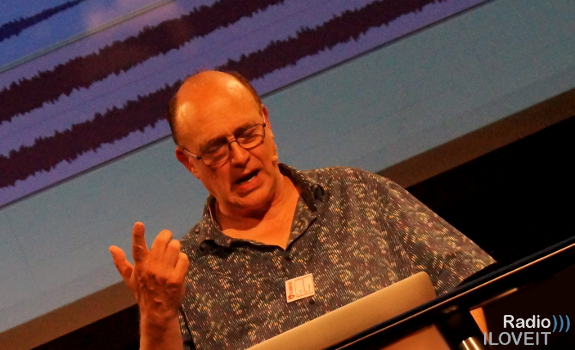
Dave Foxx explains that PPM-measured stations, wanting to keep listeners tuned in, have different imaging requirements than diary-measured ones, wanting to create top-of-mind brand recall (image: Thomas Giger)
Use your FX effectively
He illustrates his point about brand expectation and sonic identity by playing a sounder from the TV series Scandal:
“Every time there’s a transition, they have that little computer/camera sound effect. It telegraphs to the viewer: ‘we are changing scenes’. I like to do the same thing when I’m doing promos, etcetera. When I first started, I would begin every promo with a short burst or tone.” He plays a montage of several different ‘promo starters’ that he’s been using at Z100 over the years:
Elements like these can give your station (and your production) a unique profile.
Enhance your PPM friendliness
Most of the promo starters that he played as an example, not only begin with an attention-grabbing sounder, but also with the station call. A member of the audience would like to know if he also used these during his later years at Z100. “After a while, I realised: because we have this signature sound, we don’t really need to do that anymore. With the advent of PPM, it became less necessary, as you weren’t striving for quarter hours anymore; you were striving to get people to stay listening. It was more effective to just launch right into your story, get it done, and at the end say: Z100.” He’s now using his concept for Most Requested Live promos that he creates on a weekly basis for this syndicated show, airing on about 160 stations across the US.
Leverage your team’s experience
Another audience member is asking whether Z100 or iHeartRadio are actively testing jingles, sweepers and promos through focus groups or other research. As far as Dave Foxx knows, this doesn’t happen yet. “I’m sure that some Senior Vice President will come up with that at some point, but we’ve got some of the best programming minds in the world”, he says in reference to the line-up he showed at the beginning. “I would trust their opinion over any focus group. How do you even couch that into a question for a focus group?” He feels like imaging doesn’t need to be tested, as long as it’s bright, fun, in the ‘now’, and quick. “Even if they don’t like it, it’s gonna’ get them into the next song.”
“It will improve everything you do by a factor of 10”
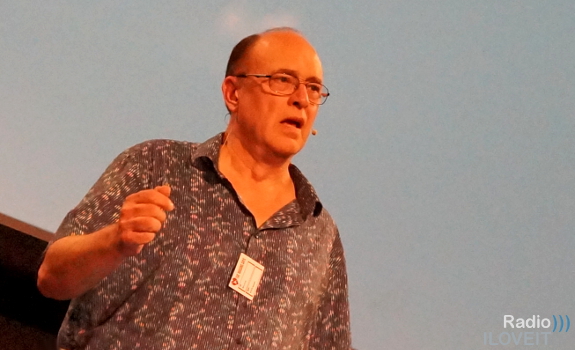
Conjuring sensations and/or triggering emotions makes powerful imaging (image: Thomas Giger)
See your audience’s perspective
In answer to a good question from the audience about the role of emotion in appealing to ‘Mika’, Foxx confirms that “emotions are everything. You will never ever convince anybody intellectually, but you will get there with emotions. Most of the time at ‘Z’, I was approaching her with the idea of fun. I tried to keep humour self deprecating: not making fun of the audience; making fun of me.” A friend of his, also an imaging producer, had a program director who used to walk into the studio with jokes he wanted to include in promo, while the humour was anything but target-friendly. The PD did not realise that it was a recipe for disaster. In fact, he used his authority to push his ideas. The producer was uncomfortable about dealing with it, so Dave advised: “Ask your PD to tell the joke to someone who fits the demo. Don’t say it that way. Say: that’s a great joke! Tell it to our phone ops, because they’re in our demo.” The PD went out and did that. “They sat and looked at him like he had two heads… He stopped doing it that day.”
Activate your listener’s imagination
So how to add emotion? “Music and rhythm has a lot to do with it. When you can get a rhythm to trip somebody’s heart, it automatically goes to that little part of your brain called Broca’s area”. He says we can communicate through words or sounds that we have given an emotional meaning, just like our other senses can cause us to respond in a certain way. “Smelling bacon in the morning has its own emotion attached to it. Smelling coffee in the morning has a different emotion, but a really good one, for most people. If you can create that kind of sensation, you’re a thousand miles ahead. The words you use, are so important. That is the birthplace of your creativity. Everything that happens after it’s written, grows from that seed.” His advice is to use words that convey a certain colour or smell or touch, instead of intellectual, grey words. “You don’t want any grey in your promo or commercial. You want it to be all bright red; bright blue; bright green! Even when it’s quiet, it needs to be shouting ‘fun’ or ‘sympathy’ or ‘love’ or whatever you’re trying to promote.”
Make your story meaningful
A great copywriting tip is staying away from words that have little or no meaning, or from words that mean different things to different people. “If I say: a woman is beautiful, and they can’t see her, I might be looking at Julia Roberts, and they might be thinking of Jennifer Lawrence.” So rather use words that are solid: “Just the word ‘coffee’ helps conjure that smell from people. If you can find those words that have a place in the heart, it will improve everything you do by a factor of 10. It starts with the writing. If the writing is right, everything else can be right, as starting with the right words makes it easy to find the right music and effects; all you need to really push that emotion out there. If you hit the Broca’s area; open up that trapdoor in your listener’s mind, pour in the idea — one or two or three words, that’s all you can do — you’ve won. You have taken the thought that started in your mind, and transplanted it, with as little distortion as possible, into the head of your listener, and into the heart of their psyche. That’s when production totally works.”
Header image: Thomas Giger





Add Your Comment